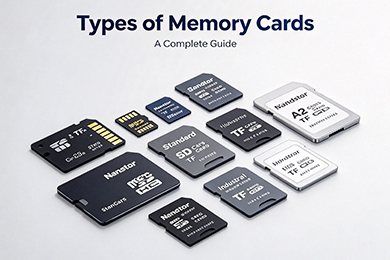
Nowadays, memory cards become essential storage accessories. Almost every smart device needs removable memory expansion. However, many buyers cannot tell the different types of memory cards. In fact, various memory cards fit totally different usage scenarios. Furthermore, wrong choices often cause slow speed or early damage.
Therefore, we prepare this detailed memory card classification guide. It helps individual users and bulk buyers pick the right card quickly. Meanwhile, it avoids unnecessary replacement costs and after-sales problems.
1. Basic Classification: SD Card vs TF Card
First of all, most people mix up SD cards and TF cards. Actually, these two are the most common types of memory cards on the market.
TF cards, also known as Micro SD cards, feature ultra-small size. For this reason, they fit compact devices such as phones, drones and dash cams. Besides, TF cards can turn into standard SD cards with a simple adapter.
On the other hand, standard SD cards are larger in size. They mainly work for cameras, laptops and desktop card readers. By contrast, SD cards rarely apply to mini portable devices.
2. Classification by Application Performance (A1 / A2)
Apart from size classification, memory cards are divided by application performance grades. This standard is very important for smart device storage expansion.
A1 memory cards focus on basic daily operation. They offer stable speed for simple file storage. Moreover, they fit ordinary smartphones and casual media storage.
A2 memory cards are upgraded versions. Notably, they support faster app loading and random reading. In addition, A2 cards perform better for running apps directly from the memory card. Thus, they are the best choice for smart IoT devices and high-end mobile phones.
If you need high-speed application-level storage, check our professional model: A2 TF Card
3. Classification by Durability & Working Environment
Furthermore, memory cards can be split into consumer-grade and high-durable industrial-grade types. This difference decides the service life in harsh environments.
Ordinary consumer memory cards suit room-temperature daily use. They cannot support long-time continuous writing. Meanwhile, they lack vibration and waterproof protection.
High-durable memory cards are specially optimized for heavy-duty tasks. For example, they support 24/7 loop recording. Besides, they own IPX7 waterproof, anti-magnetic and shock-proof features. Therefore, they work perfectly for dashcams and surveillance devices.
For heavy-load outdoor and vehicle scenarios, our High-durable TF Card is highly recommended.
4. Classification by Video Speed Class (V10 / V30 / V60 / V90)
In addition, video speed class is a key standard for camera and video recording users. Different grades support different video resolutions.
V10 and V30 cards support 1080P and basic 4K recording. They meet daily shooting needs. On the other hand, V60 and V90 cards offer ultra-stable continuous writing. They fit professional 4K/8K high-definition video equipment.
5. Industrial-Grade Memory Cards for Special Scenarios
What’s more, industrial memory cards belong to a professional category. They differ greatly from ordinary consumer cards.
Industrial cards support ultra-wide temperature resistance. They work stably from low-temperature cold areas to high-temperature industrial workshops. Meanwhile, they feature anti-interference and long-cycle durability. Thus, they widely apply to medical devices, industrial control and automotive systems.
6. How to Choose the Right Type of Memory Card?
To sum up, you can follow simple rules for selection.
First, choose TF cards for mini portable devices. Second, pick A2 grade if you need app acceleration. Third, select high-durable cards for long-time loop recording. Finally, use industrial-grade cards for extreme temperature and industrial projects.
Custom & Wholesale Memory Card Solutions
Besides standard memory card types, Nandstor provides full OEM and ODM services. We support custom logo, packaging, file preloading and firmware customization. Meanwhile, we offer complete series including consumer, high-durable and industrial memory cards.
All products pass CE, FCC, RoHS and REACH certification. Therefore, they fully support global wholesale and cross-border sales.
Final Words
In short, understanding all types of memory cards helps you avoid wrong purchases. Whether for personal use or bulk procurement, matching the correct card type improves stability and service life greatly. Furthermore, it reduces long-term maintenance costs.