In recent years, the global storage chip market has shown a clear dual track trend of price decline and capacity upgrade. The latest market research shows that mainstream storage products represented by USB flash drives, memory cards, and solid-state drives (SSDs) are undergoing an industrial transformation of “increasing quantity without increasing price” – under the same budget, the storage capacity currently available to consumers has generally increased by 1.5 to 3 times compared to three years ago, and the threshold for large capacity data storage has been significantly reduced.
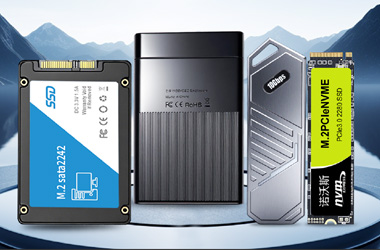
According to industry analysis firm TrendForce, the average cost per GB of consumer grade solid-state drives has dropped to zero in the second quarter of 2024. On the 8th, the US dollar decreased by 62% compared to the same period last year in 2021. Taking the 1TB NVMe protocol SSD as an example, the promotional price on mainstream e-commerce platforms has fallen below the 300 yuan mark, while five years ago, products of the same specifications were generally priced at over a thousand yuan. The field of storage cards is also showing a rapid iteration trend, with MicroSD cards priced at less than 100 yuan per 256GB capacity product, a price reduction of over 75% compared to the same period in 2019.
The breakthrough in storage chip manufacturing processes and capacity expansion are the core driving forces behind the continuous decline in prices. “Semiconductor industry analyst Li Wei pointed out that with the rapid evolution of 3D NAND flash technology from 176 layers to 232 layers, the number of storage chips that can be cut per unit wafer has increased by nearly 40%, coupled with the economies of scale brought by the continuous expansion of major global manufacturers, driving storage products into the” universal cycle “. It is worth noting that the upgrade of smartphone imaging functions and the popularization of 4k/8k video creation are further stimulating the demand for high-capacity storage, forming a virtuous cycle of coordinated promotion between supply and demand.
Market observers say that the continuous optimization of storage costs not only reshapes the digital life experience of individual users, but also provides a more economical foundation for emerging fields such as artificial intelligence training data storage and high-precision maps for autonomous driving. With the gradual maturity of QLC flash technology and the acceleration of research and development of new storage media, the performance and capacity cost-effectiveness of future storage products may show a more significant upward trend.